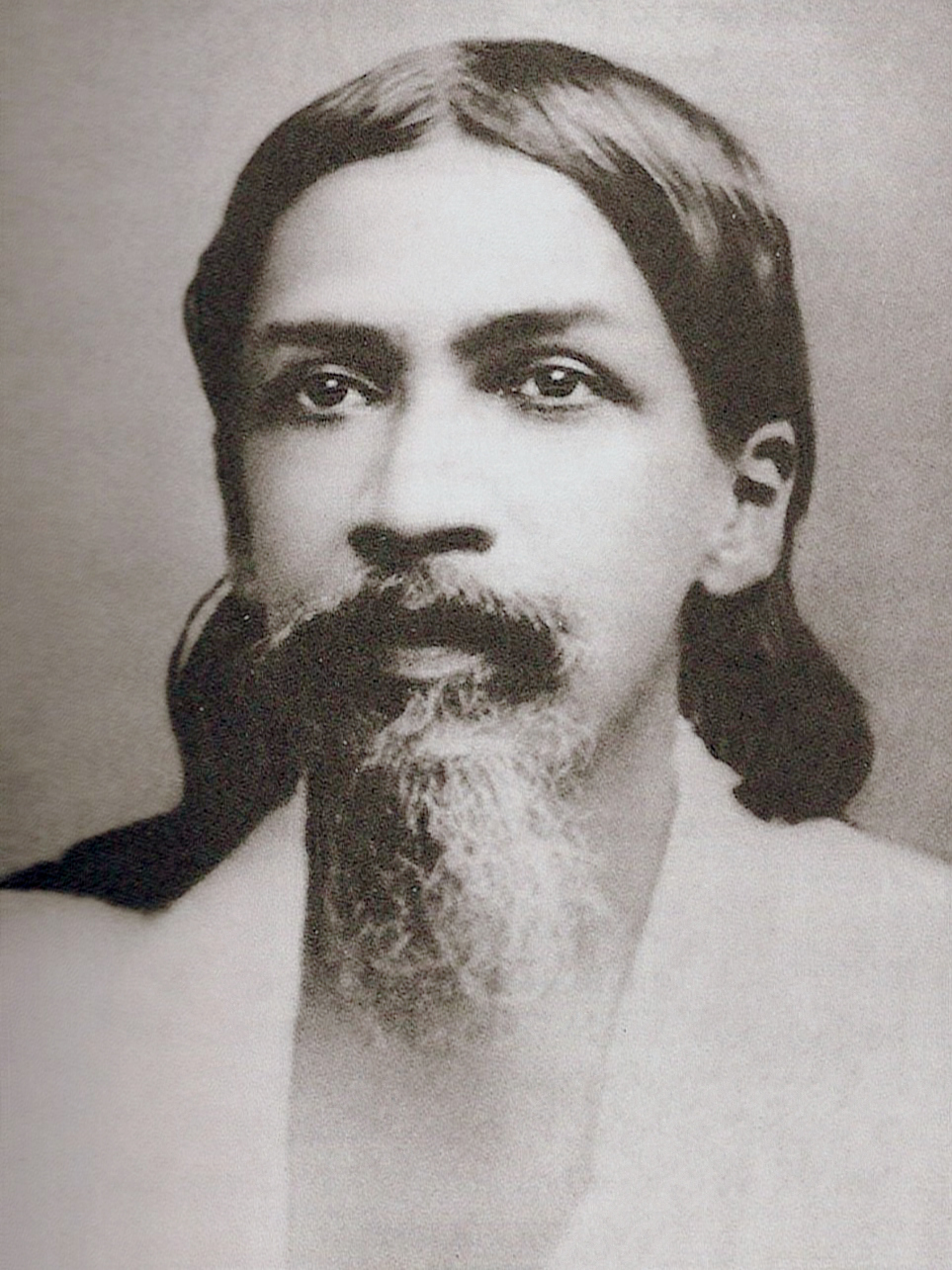
Teaching
Integral Yoga: a spiritual practice that aims not only to free consciousness but to change the whole of one's nature, including life and body. It joins the ways of knowledge, devotion and works and does not require outward asceticism. His books place it in a theory of spiritual evolution in which a consciousness beyond mind, which he called Supermind, is to emerge on earth. 1, 2, 4, 7
Who it is for
For readers who are ready for long philosophical prose and are interested in a path that includes the world instead of leaving it. His view differs from classical Advaita: he treats the world as real.
Life and places
- He was born in Calcutta on 15 August 1872 and at the age of seven was taken to England for his education. 1
- Returning to India in 1893, he worked for thirteen years in the Princely State of Baroda, and in 1906 he went to Calcutta. 1
- In 1910 he withdrew from politics and went to Pondicherry. 1
- In 1926, with the help of the Mother, he founded the Sri Aurobindo Ashram; he died on 5 December 1950. 1
Where to start
- The Mother (1928) is a short book of six chapters: the first two describe aspiration, rejection, surrender and grace, the last the Divine Mother and her four powers. The first chapter of The Synthesis of Yoga, 'Life and Yoga', sets out the aim of his yoga in a few pages. Both are free to read as PDFs on the Ashram website. 3, 5, 6
Public context
- Before 1910 he was a leader of the nationalist movement in Bengal. According to the Ashram he also took part in secret preparations for an uprising; he was tried in the Alipore Conspiracy Case in 1908–09 and acquitted. 1, 2
- The supramental evolution he describes is a religious and philosophical claim; it cannot be checked. 4, 7
Works
-
The Life Divine
Book · 1939 · Sri Aurobindo Ashram Publication Department
His main philosophical work: a theory of spiritual evolution in which consciousness, involved in matter, rises through life and mind towards a 'Supermind', and a divine life on earth becomes possible. It discusses both materialism and the ascetic denial of the world.
-
The Synthesis of Yoga
Book · 1914 · Sri Aurobindo Ashram Publication Department
His account of the traditional yogas of works, knowledge and devotion and of his own Integral Yoga, which seeks to include the whole of life. The book was written in instalments and revised only in part.
-
Savitri: A Legend and a Symbol
Book · 1950 · Sri Aurobindo Ashram Publication Department
An epic poem in blank verse that turns a story from the Mahabharata into a symbol of the soul's spiritual destiny. He worked on it for much of his later life.
-
Letters on Yoga
Book · 2012 · Sri Aurobindo Ashram Publication Department
His letters to disciples, arranged by subject in four volumes: foundations, practice, experiences and the transformation of human nature in the Integral Yoga.
-
The Mother
Book · 1928 · Sri Aurobindo Ashram Publication Department
A short book on the attitude his yoga asks for: aspiration, rejection of what is false, surrender and grace. The last chapter describes the Divine Mother and her four powers. The linked volume adds his letters about the Mother.
The short summaries are ours.
In their own words
Short passages in the words of Sri Aurobindo, each with its source. Where the quoted text is not in the language of this page, a translation follows and says whose it is.
-
There are two powers that alone can effect in their conjunction the great and difficult thing which is the aim of our endeavour, a fixed and unfailing aspiration that calls from below and a supreme Grace from above that answers.
The Mother · Chapter I, opening sentence, p. 3 (Complete Works vol. 32, 2012) · sriaurobindoashram.org -
Consciousness is the great underlying fact, the universal witness for whom the world is a field, the senses instruments.
The Life Divine · Book One, chapter III 'The Two Negations: 2. The Refusal of the Ascetic', p. 22 (Complete Works vols. 21–22, 2005) · sriaurobindoashram.org
Documented teaching relationships
-
Collaboration with Mirra Alfassa (The Mother)
Auroville describes the personal meeting in 1914, the lasting collaboration from 1920 and Mirra Alfassa as the organiser of the ashram. The relationship is recorded as a collaboration.
Stated by an institution · auroville.org
Teaching relationships are documented statements. They confer no trust and do not attest realisation.
Sources
- Sri Aurobindo · Introduction · Sri Aurobindo Ashram The ashram he founded with the Mother; official short biography accessed 10 Oct 2026
- A Life Sketch · Sri Aurobindo Ashram His own account written in the third person, reproduced by the Ashram accessed 10 Oct 2026
- His Writings · Sri Aurobindo Ashram The Ashram's list of the Complete Works with publication notes and a copyright statement accessed 10 Oct 2026
- Sri Aurobindo and His Yoga (FAQ) · Sri Aurobindo Ashram The Ashram's summary of his yoga for visitors accessed 10 Oct 2026
- The Mother with Letters on the Mother (Complete Works of Sri Aurobindo, vol. 32) His own writings, edited by the Ashram (2012) accessed 10 Oct 2026
- The Synthesis of Yoga (Complete Works of Sri Aurobindo, vols. 23–24) His own work, edited by the Ashram (1999) accessed 10 Oct 2026
- The Life Divine (Complete Works of Sri Aurobindo, vols. 21–22) His own work, edited by the Ashram (2005) accessed 10 Oct 2026
Compiled by us from the sources listed. Last checked 11 Oct 2026.
This description is factual. It contains no recommendation, ranking or assurance. Statements about effects are those of the respective source.