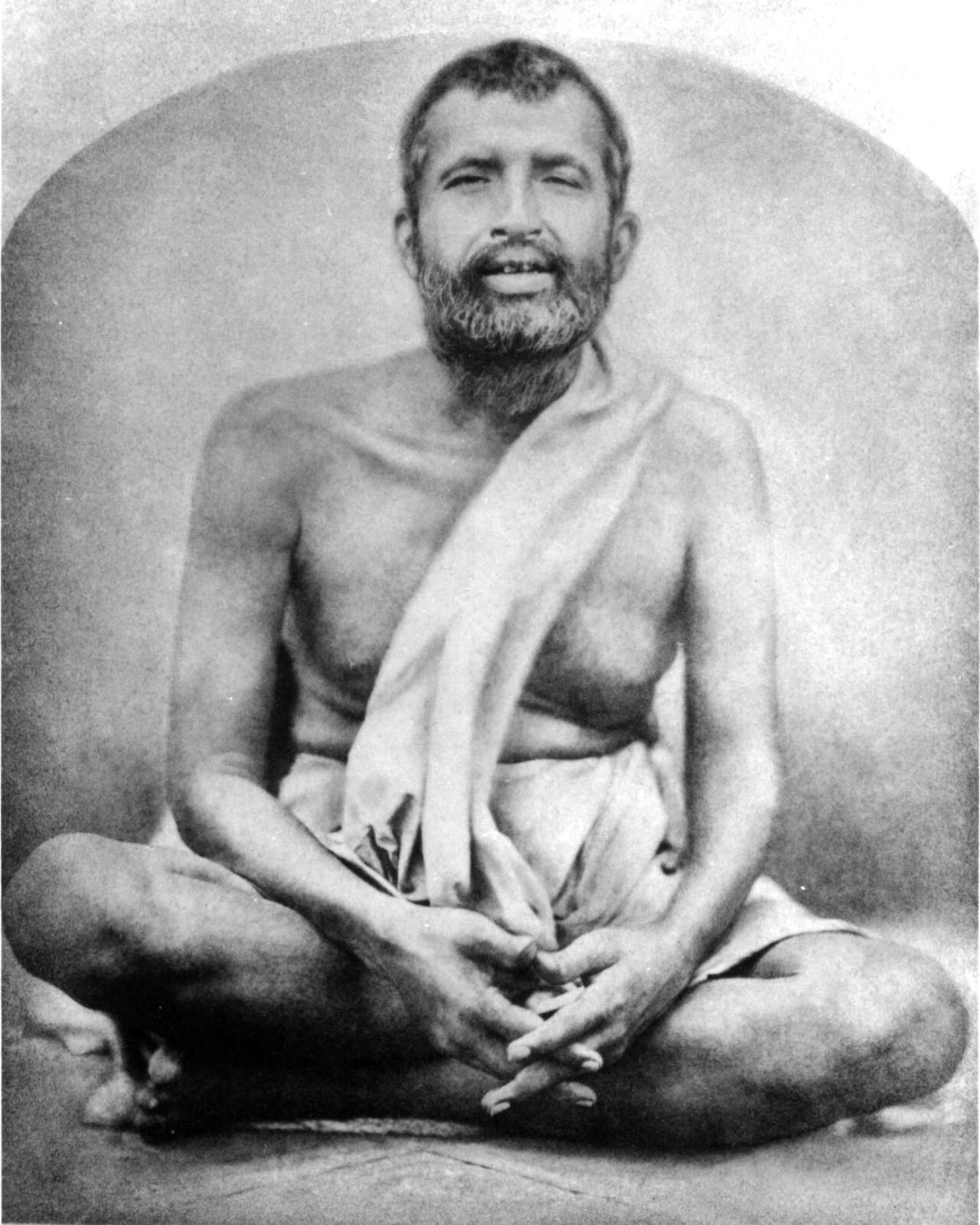
Teaching
God can be realised in this life, by householders as well as monks: do your duties but keep the mind on God, practise discrimination between the eternal and the passing, and long for God. He held that the formless Brahman and the Divine Mother are one, and that the different religions are paths to the same goal. 1, 2, 3
Who it is for
For readers who want to see devotion and non-dual knowledge held together, in the plain talk and parables of a nineteenth-century Bengali mystic.
Life and places
- He was born on 18 February 1836 in the village of Kamarpukur, about sixty miles northwest of Kolkata. 1
- At sixteen he went with his brother Ramkumar to Kolkata to assist him in his work as a priest. 1
- In 1855 Ramkumar became chief priest of the newly consecrated Kali temple at Dakshineswar, built by Rani Rasmani; when Ramkumar died a few months later, Ramakrishna was appointed priest. 1
- After he developed throat cancer in 1885, he was moved to a spacious villa in the suburbs, where his young disciples nursed him; he died on 16 August 1886. 1
Where to start
- The Gospel of Sri Ramakrishna, Swami Nikhilananda's English translation (1942) of M.'s Bengali record, gives his conversations from 1882 to 1886. Its first chapter tells how M. met him at Dakshineswar. 2, 4, 5
- In German, Martin Kämpchen translated a selection directly from the Bengali: Shrī Rāmakrishna: Gespräche mit seinen Schülern (2008). 6
Public context
- He was a priest at the Kali temple of Dakshineswar near Kolkata. His disciples, led by Swami Vivekananda, founded the Ramakrishna Order, which regards him as an incarnation of God. 1
Works
-
The Gospel of Sri Ramakrishna
Book · 1942 · Ramakrishna-Vivekananda Center, New York
Swami Nikhilananda's English translation of the Kathamrita, with an introduction on Ramakrishna's life and on Indian religious thought. It made the conversations widely known outside India.
The short summaries are ours.
In their own words
Short passages in the words of Sri Ramakrishna, each with its source. Where the quoted text is not in the language of this page, a translation follows and says whose it is.
-
Do all your duties, but keep your mind on God. Live with all — with wife and children, father and mother — and serve them. Treat them as if they were very dear to you, but know in your heart of hearts that they do not belong to you.
The Gospel of Sri Ramakrishna · Volume 1, chapter 1, 'Master and Disciple', M.'s second visit, spring 1882 · ramakrishnavivekananda.info Quoted translation: Spoken in Bengali; recorded by Mahendranath Gupta (M.) in the Kathamrita; English translation by Swami Nikhilananda (1942). -
Thus Brahman and Sakti are identical. If you accept the one, you must accept the other. It is like fire and its power to burn.
The Gospel of Sri Ramakrishna · Volume 1, chapter 5, 'The Master and Keshab', 27 October 1882 · ramakrishnavivekananda.info Quoted translation: Spoken in Bengali; recorded by Mahendranath Gupta (M.) in the Kathamrita; English translation by Swami Nikhilananda (1942).
Documented teaching relationships
-
Personal teacher of Swami Vivekananda
Vivekananda first met Sri Ramakrishna at Dakshineswar in November 1881 and was his disciple until Ramakrishna's death in 1886.
Stated by an institution · belurmath.org
Teaching relationships are documented statements. They confer no trust and do not attest realisation.
Sources
- Sri Ramakrishna · Belur Math Biography by the Ramakrishna Math and Ramakrishna Mission, the order founded by his disciples; devotional accessed 10 Oct 2026
- The Gospel of Sri Ramakrishna, chapter 1 · Master and Disciple Conversations recorded by M. (Mahendranath Gupta), in Swami Nikhilananda's English translation; online copy accessed 10 Oct 2026
- The Gospel of Sri Ramakrishna, chapter 5 · The Master and Keshab Conversation of 27 October 1882 recorded by M., in Swami Nikhilananda's English translation; online copy accessed 10 Oct 2026
- The Gospel of Sri Ramakrishna · preface by Swami Nikhilananda Translator's preface on M.'s diaries and on his own method of translation accessed 10 Oct 2026
- Swami Nikhilananda · Ramakrishna-Vivekananda Center of New York Page of the centre that published the Gospel; describes it as a complete translation of the Kathamrita accessed 10 Oct 2026
- Shrī Rāmakrishna: Gespräche mit seinen Schülern (2008) · German National Library Library catalogue record accessed 10 Oct 2026
Compiled by us from the sources listed. Last checked 11 Oct 2026.
This description is factual. It contains no recommendation, ranking or assurance. Statements about effects are those of the respective source.