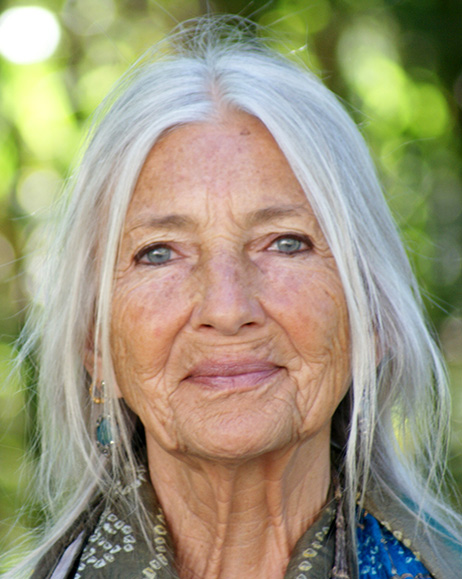
Who it is for
For people drawn to direct self-enquiry in the Papaji line who like short, plain answers and informal meetings.
Life and places
- She was born in Namur, Belgium, in 1947 and lived with her family in the Belgian Congo until 1960, when the family emigrated to Belgium. 1
- She travelled to India by road and lived by the Ganges in Rishikesh, where she met H. W. L. Poonja at the end of 1968. 1
- In 1971 she went with him to Europe, where he had been invited to give satsang, and after a stay in Venezuela she moved to Brussels in 1981. 1
- In 2004 she moved to Portugal with her mother; she lives near the ocean in the Algarve. 1
Public context
- She met H. W. L. Poonja (Papaji) in Rishikesh in 1968, became his disciple and later his wife; their daughter Mukti was born in 1972. 1, 5, 9
- She has given satsang since 1998. She lives in the Algarve, Portugal, and meets people in a private house near Aljezur, usually in English; there is no ashram or community around her. 1, 3
Works
-
Clin d'œil sur l'Être (A Glimpse of Being)
Article · 1999 · 3e millénaire
A French magazine interview on satsang, the question 'Who am I?' and suffering seen as a wave on the ocean. It is taken from a video interview by Ojas de Ronde.
-
Tout est inclus (Everything Is Included)
Article · 1999 · 3e millénaire
A French magazine interview from a retreat on Corfu in June 1999, on satsang as one's natural state, awakening beyond the idea of woman or man, and the fire for freedom.
-
Ganga Mira · Buddha at the Gas Pump, episode 347
Video · 2016 · Buddha at the Gas Pump
A long English interview by Rick Archer about her meeting with Poonja, life with him, the end of seeking and her satsang, with questions from listeners.
The short summaries are ours.
In their own words
Short passages in the words of Ganga Mira, each with its source. Where the quoted text is not in the language of this page, a translation follows and says whose it is.
-
Who you really are is here, just now regardless of the states of your mind. You are ever your Self.
Home page, quotation at the top · gangamirasatsang.com -
Liberation is not to have no thoughts. Liberation is not to care anymore about the flow of the mind, which can appear or not, because the so-called reality of the mind has been demystified.
Ganga Mira · Buddha at the Gas Pump, episode 347 · Transcript, section Thoughts, mind, and liberation (video chapter from 00:24:10) · batgap.com Recorded: Interview by Rick Archer, 21 May 2016; transcript published by Buddha at the Gas Pump, transcriber not named, not compared with the video. -
Cette question n’est pas à répéter, elle est à prendre comme une flèche qu’on lance à soi-même.
This question is not to be repeated; it is to be taken like an arrow that one shoots at oneself.
Translation: ours
Clin d'œil sur l'Être (A Glimpse of Being) · p. 19, first column · gangamirasatsang.com Recorded: Interview by Ojas de Ronde (video, June 1998), printed in 3e millénaire no. 52 (1999); checked by reading the scanned page. -
L’Eveil, c’est s’éveiller à soi-même, là où ni femme ni homme n’apparaissent, là où l’idée de création et d’humanité n’a jamais été.
Awakening is awakening to oneself, where neither woman nor man appears, where the idea of creation and of humanity has never been.
Translation: ours
Tout est inclus (Everything Is Included) · p. 62, first column · gangamirasatsang.com Recorded: Interview printed in 3e millénaire no. 53 (1999), interviewer not named on the pages read; checked by reading the scanned page.
Upcoming gatherings
-
Satsang with Ganga Mira
In person Montpellier Region, France Registration and details ↗ Add to calendar
-
Satsang with Ganga Mira
In person Casa Ganapati, Rua Marechal Saldanha, 721, Porto, Portugal Registration and details ↗ Add to calendar
Details as announced by the organiser, times in the local time of the event. The organiser’s page is authoritative.
Documented teaching relationships
-
Learned personally with H. W. L. Poonja (Papaji)
Ganga Mira met Papaji in Rishikesh in 1968, became his student and later his wife.
Self-reported · gangamirasatsang.com
Teaching relationships are documented statements. They confer no trust and do not attest realisation.
Sources
- Biography · Ganga Mira Her own website; biography in the third person accessed 10 Oct 2026
- Ganga Mira Quotes and Pictures Her own website; quotations shown as pictures accessed 10 Oct 2026
- Satsang in Portugal with Ganga Mira Her own website; place, language and conditions of her meetings accessed 10 Oct 2026
- Videos and Audios · Ganga Mira Her own website; satsang recordings from 2014 and 2015 and a link to her YouTube channel accessed 10 Oct 2026
- Mukti De Coux: Foreword to the German edition of Nothing Ever Happened, vol. III (2019) Her daughter's account of the family life with H. W. L. Poonja, PDF on her website accessed 10 Oct 2026
- Mira Decoux: Clin d'œil sur l'Être · 3e millénaire no. 52, 1999 French magazine interview, scan on her website; taken from a 1998 video interview by Ojas de Ronde accessed 10 Oct 2026
- Ganga Mira · Buddha at the Gas Pump, episode 347 Interview series by Rick Archer; episode page with biography, date and chapter list accessed 10 Oct 2026
- 347. Ganga Mira Transcript · Buddha at the Gas Pump Transcript of the interview of 21 May 2016 published by the series; not compared with the video accessed 10 Oct 2026
- Visit of Sri Ganga Mira (April 12–14, 2017) · Ajatananda Ashram Ashram in Rishikesh whose teacher is a long-time friend; report of her visit accessed 10 Oct 2026
Compiled by us from the sources listed. Last checked 11 Oct 2026.
This description is factual. It contains no recommendation, ranking or assurance. Statements about effects are those of the respective source.