Who it is for
For people who want a simple, bodily practice they can take into everyday life, and for those interested in a Buddhist view of non-separation.
Life and places
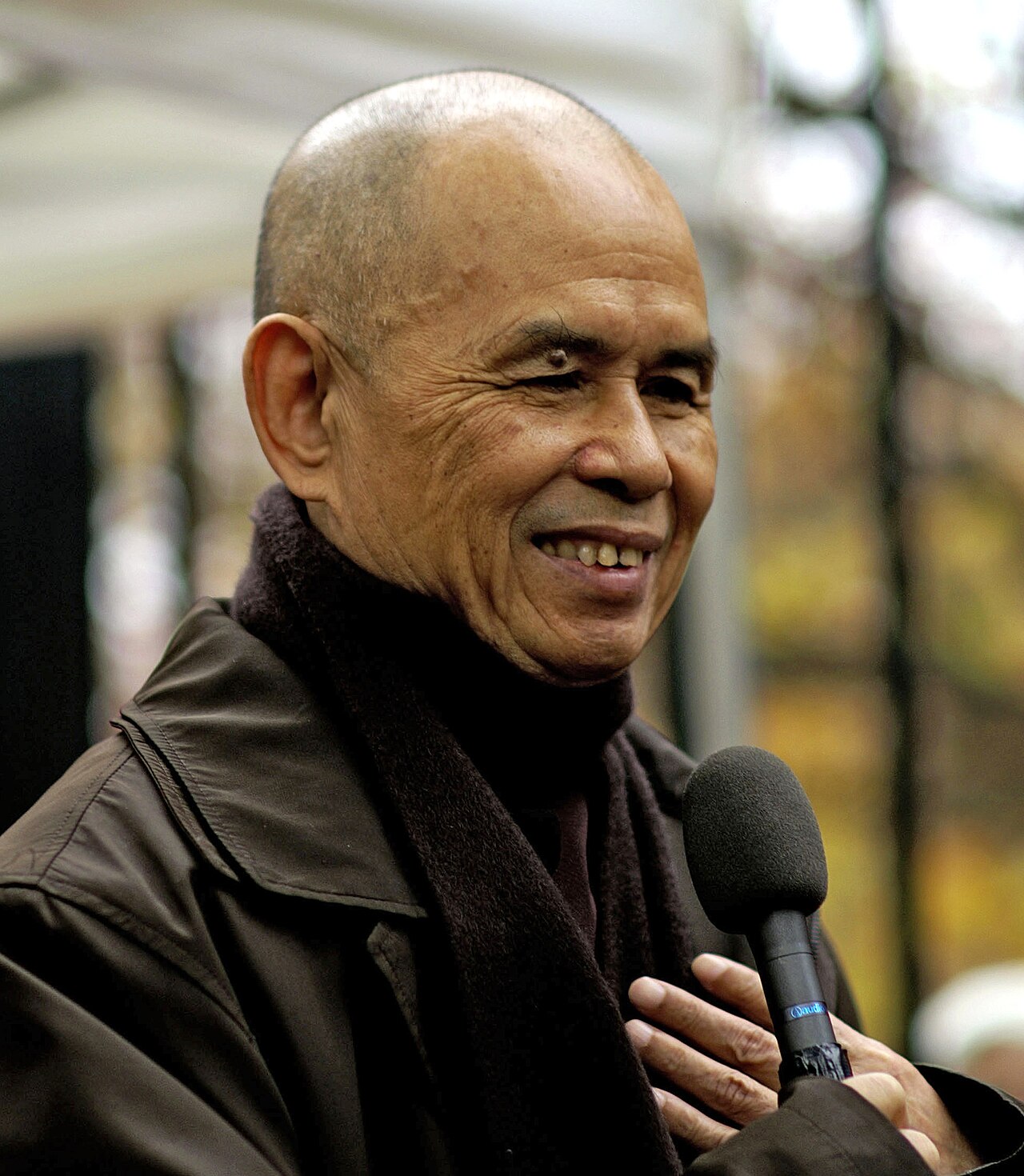
- He entered Tu Hieu Temple in Huế as a novice monk at the age of sixteen. 1
- In the early 1970s he lectured on Buddhism at the Sorbonne in Paris; in 1975 he set up the Sweet Potato community near Paris, and in 1982 he moved to a much larger site in south-west France that became Plum Village. 1
- After a severe stroke in November 2014 he moved to the Thai Plum Village centre in Thailand, and in 2018 to Tu Hieu Temple, where he died on 22 January 2022. 1
Public context
- He was a Vietnamese Zen monk, born in Huế in 1926, who lived in exile from 1966 to 2005 and died in Huế in 2022. 2, 3
- He founded the Plum Village monastery in south-west France in 1982. His community continues his teaching there and in other centres, including the European Institute of Applied Buddhism in Waldbröl, Germany. 1, 2
Works
-
The Miracle of Mindfulness
Book · 1976 · Beacon Press
A short manual of mindfulness in daily life, written for the social workers of his School of Youth for Social Service in Vietnam. It describes breathing, walking and everyday tasks as meditation.
-
Peace Is Every Step: The Path of Mindfulness in Everyday Life
Book · 1991 · Bantam Books
Short chapters on mindfulness in everyday situations, on handling difficult feelings and on peace in relationships and society. His community names it among his best-known books.
-
Call Me By My True Names: The Collected Poems
Book · 1993 · Parallax Press
His collected poems from several decades. The title poem grew out of a letter about a young refugee girl and asks the reader to recognise themselves in victim and perpetrator alike.
-
Vietnam: Lotus in a Sea of Fire
Book · 1967 · Hill and Wang
His account of the Buddhist peace movement in the Vietnam War and its proposals for peace. According to his community, the term engaged Buddhism first appears here, and Martin Luther King Jr. quoted the book in 1967.
The short summaries are ours.
In their own words
Short passages in the words of Thich Nhat Hanh, each with its source. Where the quoted text is not in the language of this page, a translation follows and says whose it is.
-
If you are a poet, you will see clearly that there is a cloud floating in this sheet of paper. Without a cloud, there will be no rain; without rain, the trees cannot grow; and without trees, we cannot make paper.
Awakening of the Heart: Essential Buddhist Sutras and Commentaries · Commentary on the Heart Sutra, opening paragraph (excerpt in Lion's Roar, 2022) · lionsroar.com -
Please call me by my true names, so I can hear all my cries and my laughter at once, so I can see that my joy and pain are one.
Call Me By My True Names: The Collected Poems · Please Call Me by My True Names, second-to-last stanza · plumvillage.org -
“I have arrived, I am home” means: I don’t want to run anymore. I’ve been running all my life, and I’ve arrived nowhere. Now I want to stop. My destination is the here and now, the only time and place where true life is possible.
Section Walking, quotation attributed to him · plumvillage.org
Documented teaching relationships
-
Recognised teaching areas of Roshi Joan Halifax
Joan Halifax received the Lamp Transmission as a dharma teacher from Thich Nhat Hanh; an interview introduction from 1997 dates it to 1990 and calls her a Dharmacarya in the Tiep Hien Order.
Biographical tradition · dlbs.liberal.ntu.edu.tw , chronicleproject.com
-
Spiritual friendship with Tenzin Gyatso (14th Dalai Lama)
On Thich Nhat Hanh's death in January 2022, the Office of the Dalai Lama wrote that the Dalai Lama was saddened to learn that his friend and spiritual brother had passed away, and published his condolence message.
Stated by an institution · dalailama.com
-
Personal encounter with Catherine Ingram
Catherine Ingram's book In the Footsteps of Gandhi: Conversations with Spiritual Social Activists (Parallax Press, 1990) contains her interview with Thich Nhat Hanh.
Stated by an institution · bibliothek-david-steindl-rast.ch , library.upol.cz
Teaching relationships are documented statements. They confer no trust and do not attest realisation.
Sources
- The Life Story of Thich Nhat Hanh · Plum Village Website of his monastic community; short biography with dated photographs accessed 10 Oct 2026
- Thich Nhat Hanh: Extended Biography · Plum Village Website of his monastic community; extended biography edited by two of his nuns, with references accessed 10 Oct 2026
- Thich Nhat Hanh's Health · Plum Village Website of his monastic community; news on his illness, death and funeral accessed 10 Oct 2026
- The Art of Mindful Living · Plum Village Website of his monastic community; the basic practices, with a quotation from him accessed 10 Oct 2026
- The Heart Sutra: the Fullness of Emptiness · Lion's Roar, 2022 Buddhist magazine; excerpt from his book Awakening of the Heart (2012), reprinted with the publisher's permission accessed 10 Oct 2026
Compiled by us from the sources listed. Last checked 11 Oct 2026.
This description is factual. It contains no recommendation, ranking or assurance. Statements about effects are those of the respective source.