Who it is for
For readers who want the classical texts of Advaita and are willing to work through scripture commentary and Sanskrit terms.
Life and places
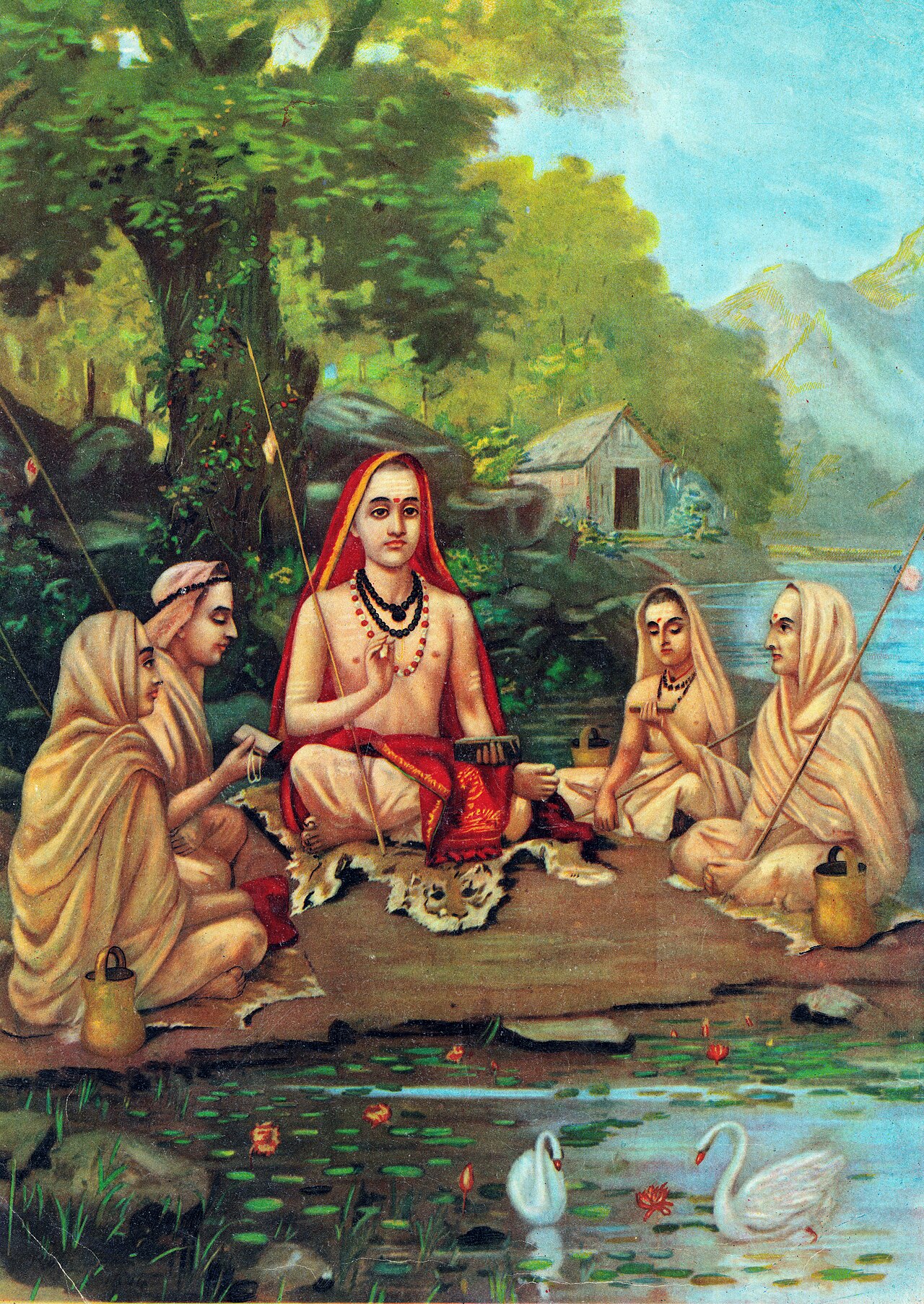
- His dates are uncertain: early scholars placed him from 788 to 820 CE, while others date him to around 700 to 750 CE or to the late seventh and early eighth centuries. 1
- Accounts of his life composed several centuries after his death describe him as born in Kalāḍi, in present-day Kerala. 1
- According to these accounts, he became a renouncer at a young age and spent his life travelling around the subcontinent, teaching pupils, debating and writing his works. 1
- He is said to have founded four or five principal monasteries (maṭhas) across the subcontinent and to have died at the age of thirty-two. 1
Public context
Works
-
Brahmasūtrabhāṣya (Commentary on the Brahmasūtras)
Text · Clarendon Press, Oxford (Sacred Books of the East, vol. 34)
Shankara's commentary on the Brahmasūtras, the aphorisms that sum up the Upaniṣads. It opens with his short introduction on superimposition (adhyāsa) and is his main philosophical work.
-
Bhagavadgītābhāṣya (Commentary on the Bhagavad Gītā)
Text · G. T. A. Printing Works, Mysore
Shankara's commentary on the Bhagavad Gītā. In his introduction he names knowledge of the Self, preceded by the renunciation of all works, as the way to liberation.
-
Bṛhadāraṇyakopaniṣadbhāṣya (Commentary on the Bṛhadāraṇyaka Upaniṣad)
Text · Advaita Ashrama, Mayavati
Shankara's commentary on the Bṛhadāraṇyaka Upaniṣad, one of the ten principal Upaniṣads on which he wrote commentaries.
-
Upadeśasāhasrī (A Thousand Teachings)
Text · Sri Ramakrishna Math, Madras
An independent work in a prose part and a verse part. The prose part sets out how a teacher should instruct a disciple in the knowledge of the Self.
The short summaries are ours.
In their own words
Short passages in the words of Adi Shankara, each with its source. Where the quoted text is not in the language of this page, a translation follows and says whose it is.
-
It is a matter not requiring any proof that the object and the subject whose respective spheres are the notion of the ‘Thou’ (the Non-Ego) and the ‘Ego,’ and which are opposed to each other as much as darkness and light are, cannot be identified. All the less can their respective attributes be identified.
Brahmasūtrabhāṣya (Commentary on the Brahmasūtras) · Introduction (adhyāsa-bhāṣya), opening sentences, p. 3 · archive.org Quoted translation: English translation by George Thibaut (1890) of Shankara's Sanskrit; footnote markers omitted. -
This superimposition thus defined, learned men consider to be Nescience (avidyâ), and the ascertainment of the true nature of that which is (the Self) by means of the discrimination of that (which is superimposed on the Self), they call knowledge (vidyâ).
Brahmasūtrabhāṣya (Commentary on the Brahmasūtras) · Introduction (adhyāsa-bhāṣya), p. 6 · archive.org Quoted translation: English translation by George Thibaut (1890) of Shankara's Sanskrit. -
The aim of this famous Gîtâ-Sâstra is, briefly, the Supreme Bliss, a complete cessation of samsâra or transmigratory life and of its cause. This accrues from that Religion (Dharma) which consists in a steady devotion to the knowledge of the Self, preceded by the renunciation of all works.
Bhagavadgītābhāṣya (Commentary on the Bhagavad Gītā) · Introduction, section 'Jnana-Yoga is the means to the Supreme Bliss', p. 5 · archive.org Quoted translation: English translation by A. Mahadeva Sastri (2nd edition, 1901) of Shankara's Sanskrit.
Sources
- Śaṅkara · Neil Dalal, Stanford Encyclopedia of Philosophy (2021) Peer-reviewed academic encyclopedia; dating, works and philosophy; no hagiography accessed 10 Oct 2026
- The Vedânta-Sûtras with the Commentary by Sankarâkârya, Part I, transl. George Thibaut (Sacred Books of the East 34, 1890) · Internet Archive Public-domain scholarly translation; scan of the Oxford edition; the translator's introduction gives his own critical assessment accessed 10 Oct 2026
- The Bhagavad-Gita with the Commentary of Sri Sankaracharya, transl. A. Mahadeva Sastri, 2nd edition (Mysore 1901) · Internet Archive Public-domain translation by a traditional Indian scholar, with notes following the sub-commentator Anandagiri accessed 10 Oct 2026
- Upadeshasahasri of Sri Sankaracharya, transl. Swami Jagadananda, 2nd edition (Sri Ramakrishna Math, Madras 1949) · Internet Archive Translation by a monk of the Ramakrishna Order following Ramatirtha's gloss; scan from the Digital Library of India accessed 10 Oct 2026
- Advaita Sharada · Itihasa · Sringeri Sharada Peetham Tradition source of the monastery that traces its founding to Shankara; its own account of his life and works accessed 10 Oct 2026
Compiled by us from the sources listed. Last checked 12 Oct 2026.
This description is factual. It contains no recommendation, ranking or assurance. Statements about effects are those of the respective source.