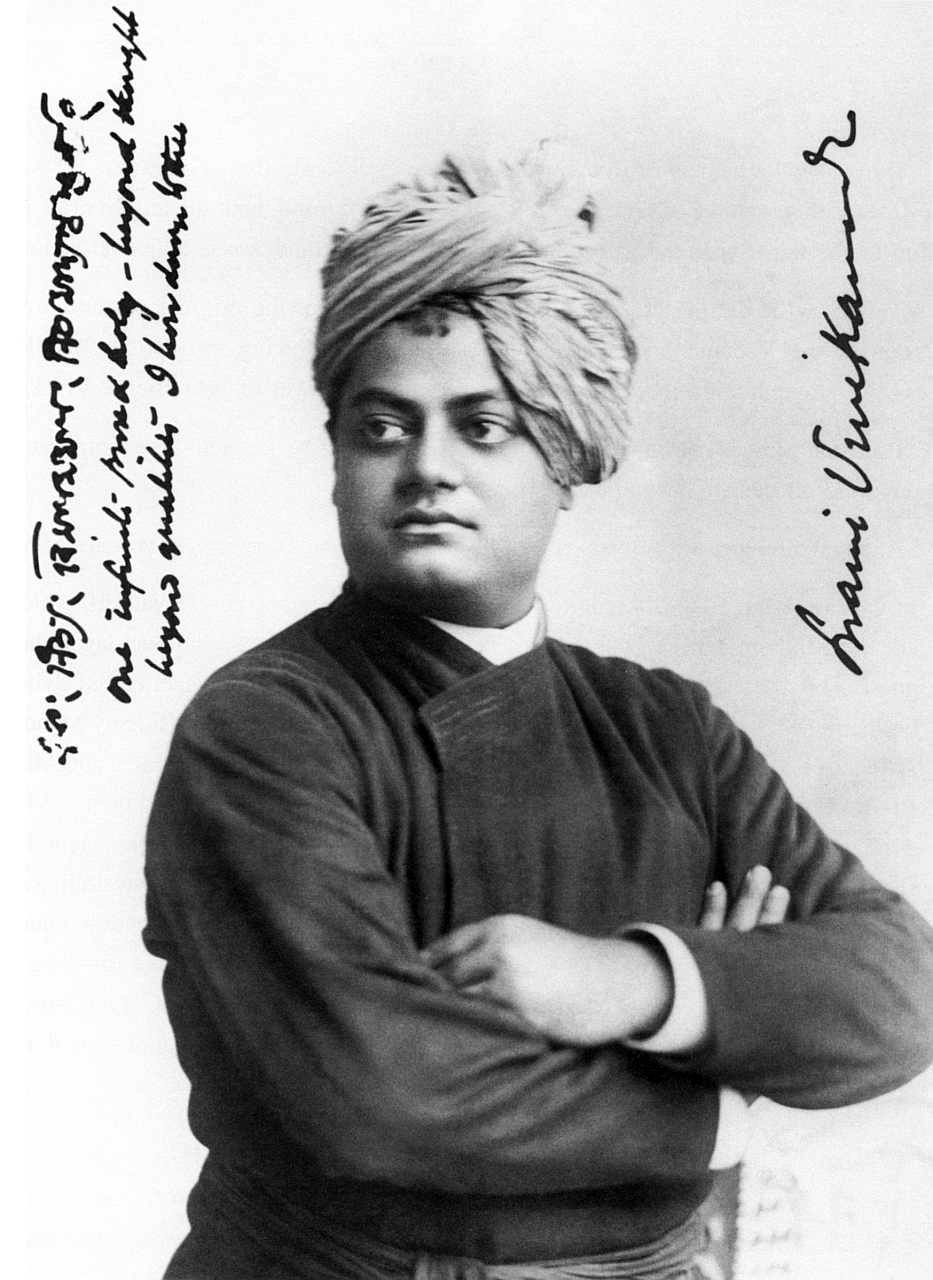
Who it is for
For readers who want the classical modern presentation of Vedanta in English, in lectures and essays from the 1890s.
Life and places
- He was born in Kolkata on 12 January 1863, and in November 1881 he met Sri Ramakrishna, who was staying at the Kali temple in Dakshineswar. 1
- After Ramakrishna's death in 1886, he and other young disciples lived together in a dilapidated building at Baranagar in north Kolkata; in the middle of 1890 he set out on a long journey through India. 1
- He left Mumbai for America on 31 May 1893, spoke at the World's Parliament of Religions in Chicago that September, and spent nearly three and a half years spreading Vedanta, mostly in the eastern United States and also in London. 1
- He returned to India in January 1897; in early 1898 he acquired a large plot of land on the western bank of the Ganga at Belur, and in June 1899 he went to the West a second time. 1
Public context
Works
-
Addresses at the World's Parliament of Religions, Chicago
Talk · 1893 · Belur Math (online text)
His six addresses at the World's Parliament of Religions in Chicago in September 1893, beginning with 'Sisters and Brothers of America'. They set out Hinduism and Vedanta for a Western audience.
-
Yoga philosophy: lectures delivered in New York, winter of 1895-6, on Raja Yoga or conquering the internal nature
Book · 1896 · Longmans, Green, London
Lectures to classes in New York on Raja Yoga, followed by a free translation of Patanjali's Yoga Sutras with his commentary. After the preface follows a four-line summary of his view of religion.
-
Vedanta philosophy: eight lectures on karma yoga (the secret of work)
Book · The Baker & Taylor Company, New York
Eight lectures on karma yoga, 'the secret of work', given under the auspices of the Vedanta Society.
-
Vedânta philosophy: lectures on jnâna yoga
Book · 1902 · Vedânta Society, New York
His lectures on Jnana Yoga. They appear as Jnana-Yoga in volume 2 of The Complete Works.
-
The Complete Works of Swami Vivekananda
Book · Prabuddha Bharata Press (early volumes)
His collected lectures, letters, poems, conversations and translations in nine volumes.
The short summaries are ours.
In their own words
Short passages in the words of Swami Vivekananda, each with its source. Where the quoted text is not in the language of this page, a translation follows and says whose it is.
-
I am proud to belong to a religion which has taught the world both tolerance and universal acceptance. We believe not only in universal toleration, but we accept all religions as true.
Addresses at the World's Parliament of Religions, Chicago · Response to Welcome, 11 September 1893, second paragraph · belurmath.org Recorded: Address given at the Parliament; text as published by Belur Math and in The Complete Works. Who took it down is not stated there. -
Each soul is potentially divine. The goal is to manifest this Divinity within by controlling nature, external and internal. Do this either by work, or worship, or psychic control, or philosophy — by one, or more, or all of these — and be free.
Yoga philosophy: lectures delivered in New York, winter of 1895-6, on Raja Yoga or conquering the internal nature · Preface, the four lines after the author's signature · en.wikisource.org -
There is but One—The Free—The Knower—Self! Without a name, without a form or stain. In Him is Mâyâ dreaming all this dream. The witness, He appears as nature, soul.
The Song of the Sannyasin · Stanza 6, lines 1-4 · en.wikisource.org
Documented teaching relationships
-
Learned personally with Sri Ramakrishna
Vivekananda first met Sri Ramakrishna at Dakshineswar in November 1881 and was his disciple until Ramakrishna's death in 1886.
Stated by an institution · belurmath.org
Teaching relationships are documented statements. They confer no trust and do not attest realisation.
Sources
- Swami Vivekananda · Belur Math (Ramakrishna Math and Ramakrishna Mission) Biography by the order Vivekananda founded; devotional in tone accessed 10 Oct 2026
- Swami Vivekananda's Speeches at the World's Parliament of Religions, Chicago, 1893 · Belur Math The order's own online text of the six Chicago addresses accessed 10 Oct 2026
- Swamiji's Room · Belur Math The order's page on the room at Belur Math where he lived and died accessed 10 Oct 2026
- Clarification on Swami Vivekananda's Voice Recording (2020) · Belur Math media The order's statement that no recording of his voice is known to survive accessed 10 Oct 2026
- The Complete Works of Swami Vivekananda, Volume 1, Raja-Yoga, Preface · Wikisource Volunteer transcription of the Complete Works; Wikisource marks the source edition as unknown accessed 10 Oct 2026
- Yoga philosophy: lectures delivered in New York, winter of 1895-6 · Wellcome Collection catalogue Library catalogue record of the 1896 London edition (the library's copy is the 9th impression of 1907) accessed 10 Oct 2026
Compiled by us from the sources listed. Last checked 11 Oct 2026.
This description is factual. It contains no recommendation, ranking or assurance. Statements about effects are those of the respective source.